GRADE
Simulate indoor. Record outdoor.
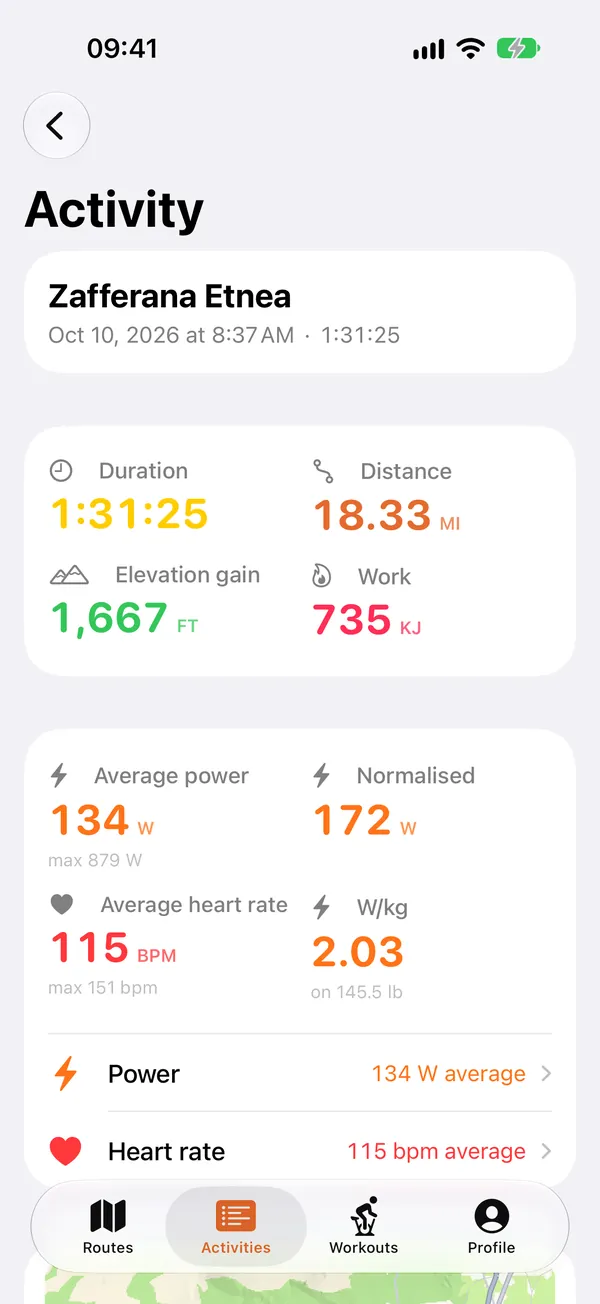
Sunday's climb, ridden in January. Bring a GPX or a FIT, record the road yourself, then pedal it for real on the trainer.
iPhone · iPad · Mac · Apple Watch
How it works
You bring the road. The trainer makes it a climb.
Bring a road
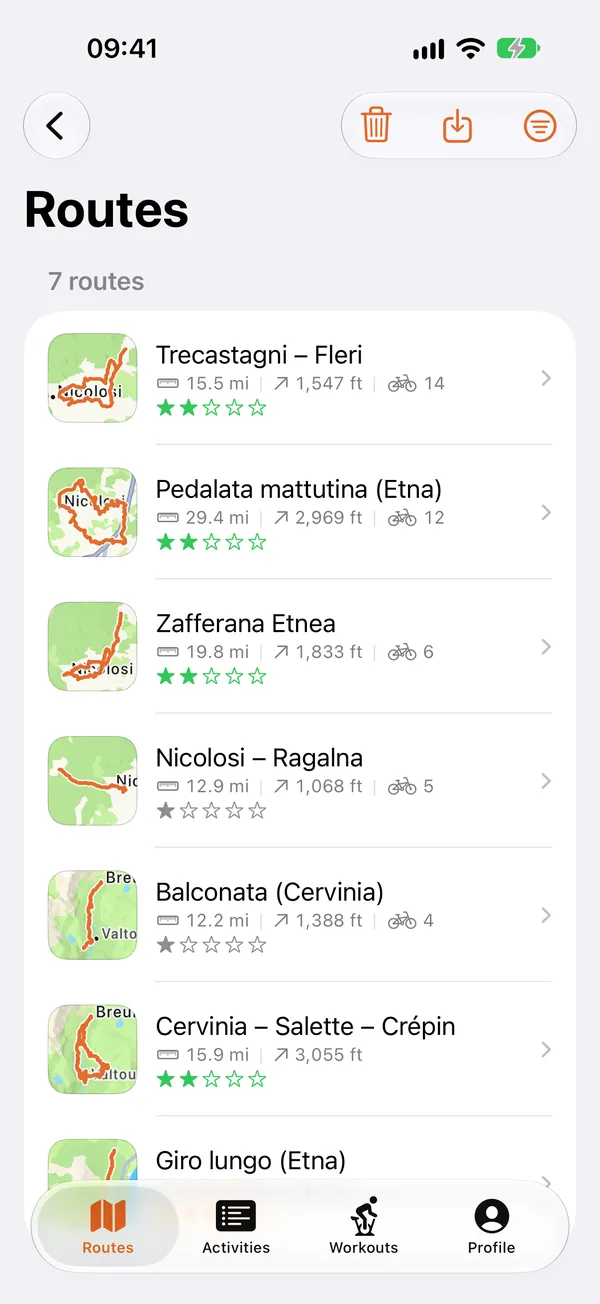
A GPX or a FIT file from your bike computer, from a race organiser, from anywhere. Or you can record one yourself while you ride a real road.
Connect the trainer
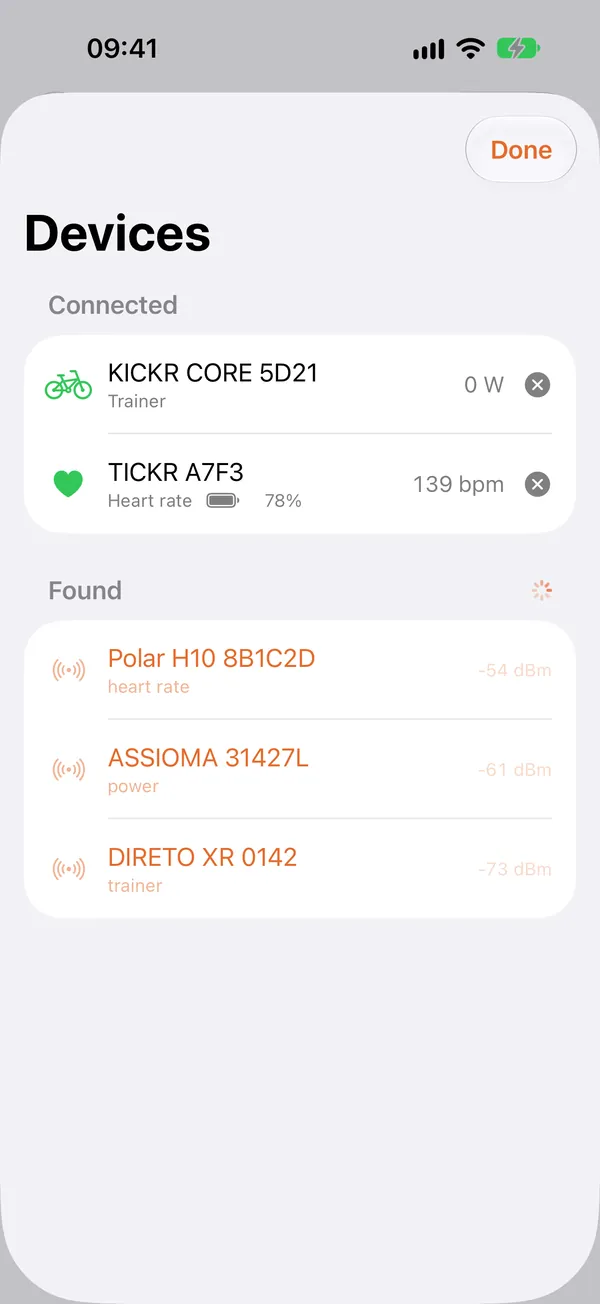
Any smart trainer or smart bike that speaks Bluetooth FTMS. No brand list, no special cases: the app negotiates what your device can actually do.
Ride the real thing
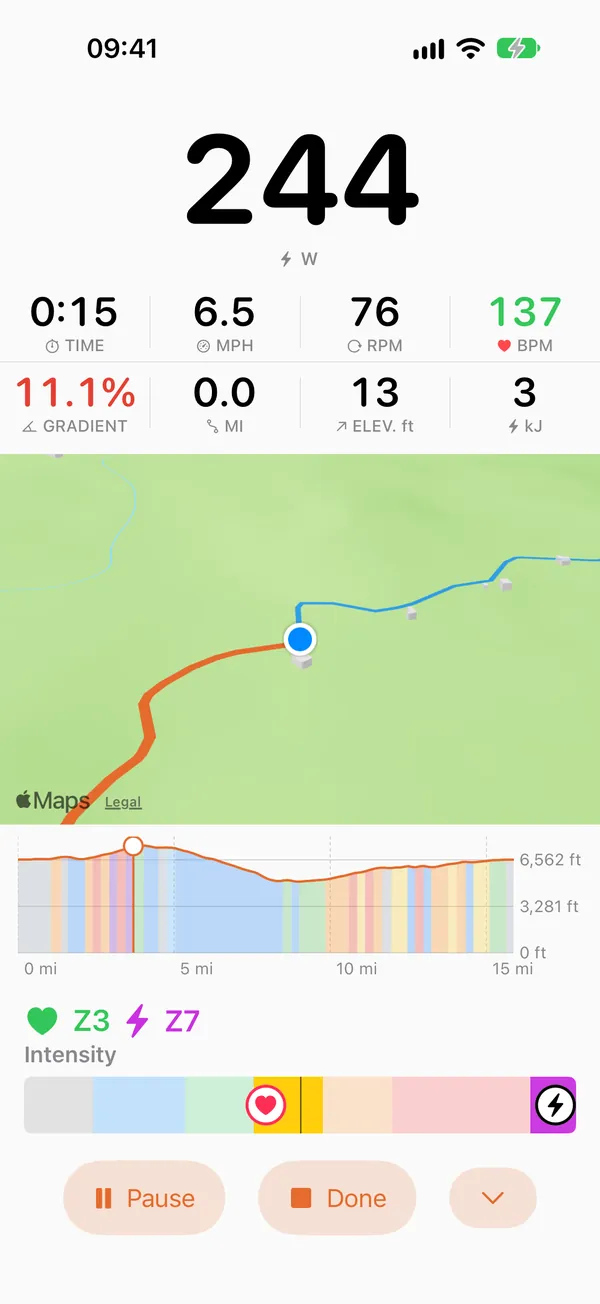
The gradient under your legs is the gradient of the real road, sent to the trainer once a second. Map, elevation profile, and a coach that speaks.
Three things it does
No virtual worlds. Just the roads you have already ridden.
Simulate a road, record a road, and understand what there is to improve.
Simulate
A noisy GPS track becomes a clean elevation profile, then real resistance. Filtered and resampled to give you the best possible experience on the trainer.
Raw GPS altitude is noisy enough to make a trainer lurch. Our proprietary filtering system adjusts the imported route and makes it practically identical to a real ride on the road.
Record
Ride outside and the road is yours forever. The app works out how you are moving on its own, pauses when you stop, and keeps the raw track.
Full support for GPX and FIT. Validated on over 68k real files and 31.4 million messages.
Understand
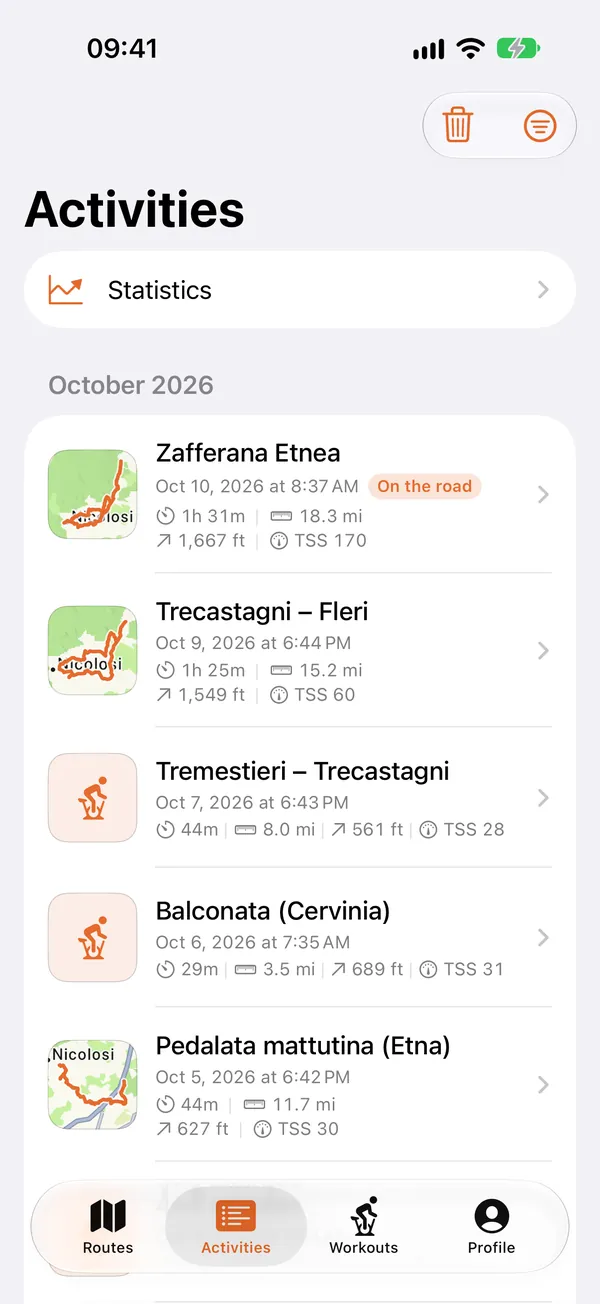
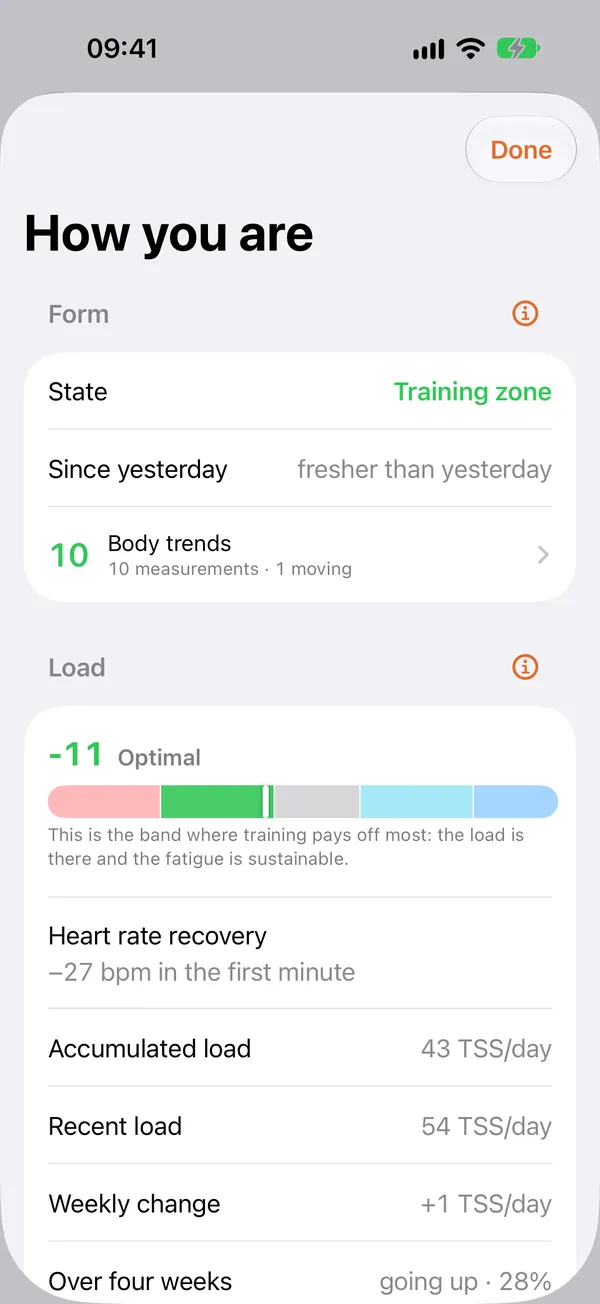
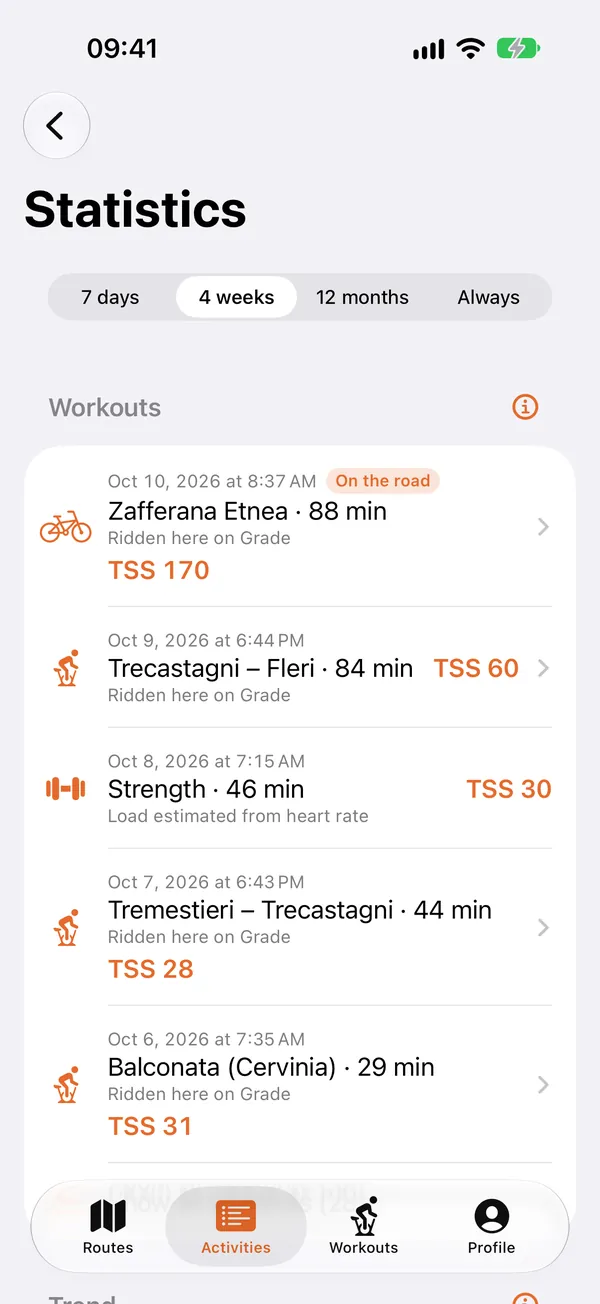
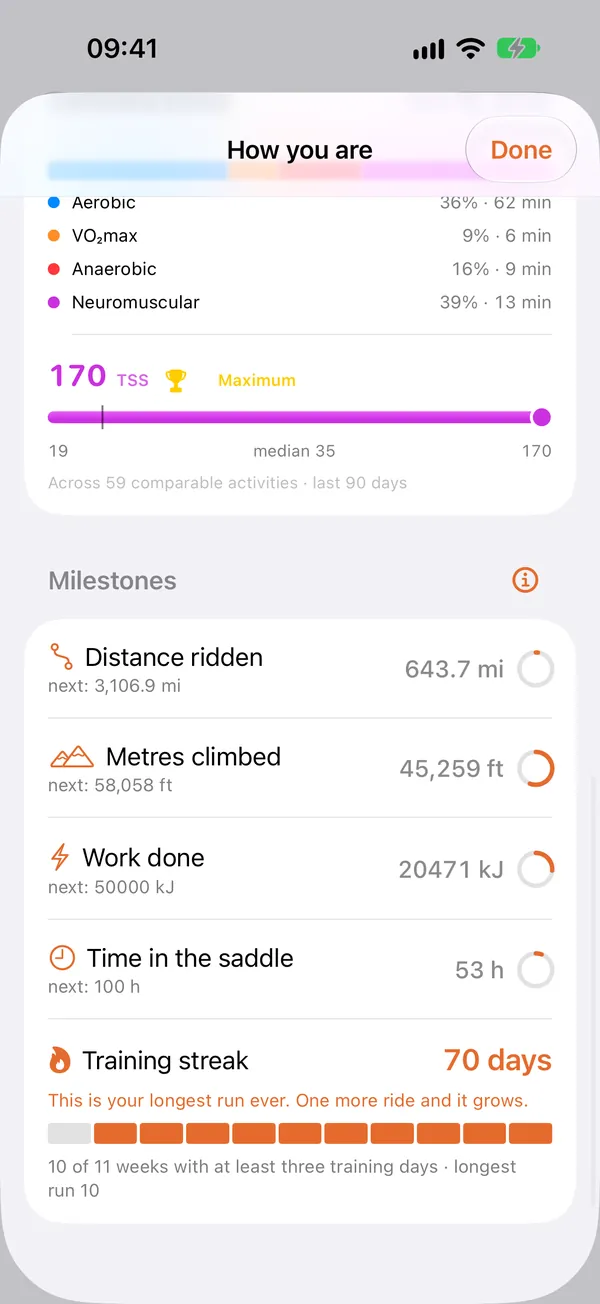
Load, form, thresholds and milestones, built from everything you do and not only from what you do here. And every number says where it came from.
Counts the runs, gym sessions and outdoor rides other apps wrote to Apple Health, with three levels of de-duplication and a list of what got in and why.
Features
It runs on your device, and the data stays yours.
Gradient, once a second
Standard FTMS simulation. If your trainer cannot do gradient, it falls back to resistance and tells you so.
A route becomes a workout
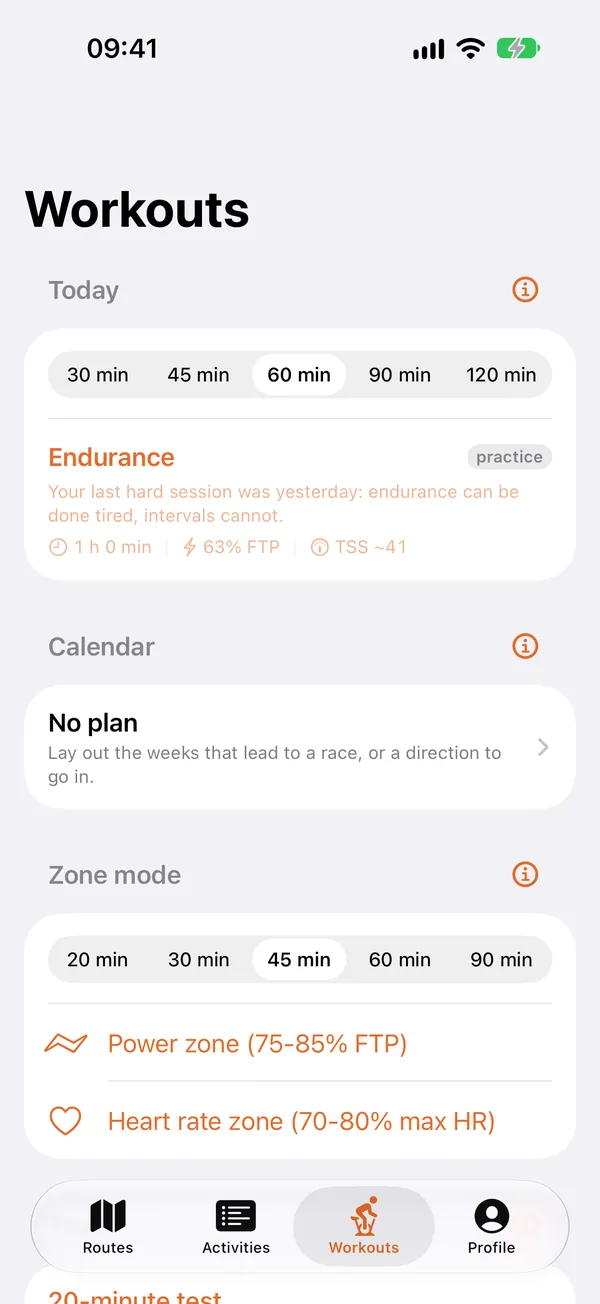
Say how long you have, and the route turns into a session of exactly that length. Climbs come first, whole, at their real gradient.
Practise one climb
Isolate a climb and repeat it. Then compare it against the last time you rode the same road, split by split.
Keep pedalling, watch something else
Picture-in-Picture keeps your numbers on screen over anything else. On the Mac it is a floating panel.
Apple Health, both ways
Rides close your rings. Resting heart rate, HRV, VO₂max, weight, sleep and your FTP. All at your fingertips.
iCloud, and nothing else
Everything you made or declared syncs through your own private iCloud. We run no server, so there is nowhere else for it to go.
A coach that speaks
On screen, on your wrist and out loud, in five languages. It speaks when there is something to say, and stays quiet the rest of the time.
Your data leaves the way it came
Export as FIT, GPX or TCX, always, free. The FIT encoder is ours and it is checked against Garmin's own decoder.
A plan for the weeks ahead
Say what you are training for, which days you have and how long. All of it is built on what the science agrees on.
Compatibility
If it speaks FTMS, it works.
The app asks your trainer what it can do and adapts. No list of approved brands, no special case for a particular model. All verified in the field.
Four platforms
One app, written for each screen it runs on.
iPhone
The cycle computer. Live Activity on the lock screen, Picture-in-Picture, in your pocket or on your bars.
iPad
The screen you prop on your trainer desk. The big dashboard, the map and the profile, all at once.
Mac
A real Mac app, tested screen by screen: sidebar, tables, the ride in its own window and a floating panel.
Apple Watch
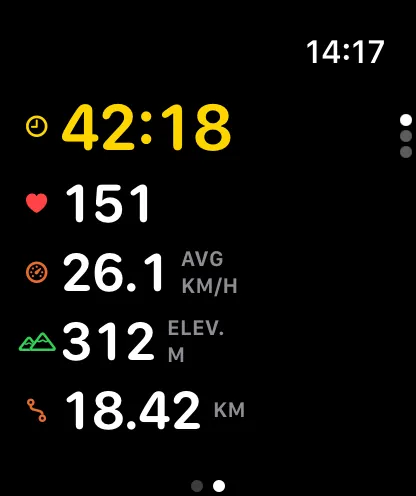
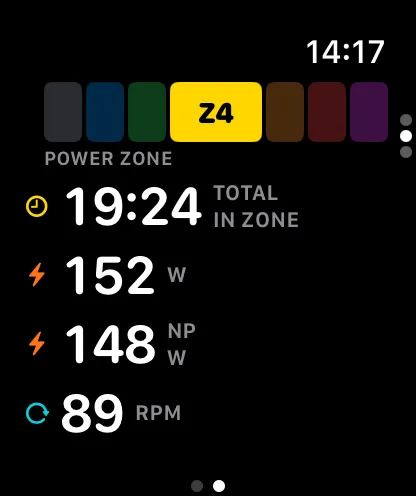
Heart rate straight from the wrist, zones, time in zone, and a haptic when the coach has something to say.
Your data
Nothing leaves your devices.
There is no backend to send anything to. Everything stays on your devices and in your iCloud.
Your own private iCloud. Rides, routes, profile and plans sync between your devices through your account, not through ours.
No account, no tracking, no analytics. The list of data types collected is empty, and it is empty because there is nowhere to collect it to.
Export is always free. Charging you for a workout you produced with your own body is bad manners. FIT, GPX and TCX, for everyone, forever.
Works with no signal. People ride in basements. Nothing important waits for the network.
What is behind it
No servers. No subscription. No one else's content.
Every decision behind this app has a story that says why it was made.

The diary
How we got here.
An occasional diary. Milestones, the problems that ate a week, and the measurements that proved me wrong. This is the story of this project. Stories for people who build, and for people who love to ride.
The number that was meant to tell you whether you are improving
Building a single index that works for a beginner and for a professional is harder than it looks. Mine broke twice on a real user, and in the end the right answer was to remove it.
Read →The trainer told me forty-two revolutions per minute
Indoor cycling apps are full of fixed numbers chosen by someone who did not know who would be pedalling. On a beginner, a fixed number is not imprecise: it is wrong, and sometimes it hurts.
Read →I built a fake trainer so I could build the real one
How you build an app that talks to hardware, when the hardware is not there.
Read →Price
Buy it once. It is yours.
Try it with the core features for as long as you like. If it earns its place, one payment unlocks everything. No subscription. Just your own fun.
Family Sharing included. Every future update included. Your data is exportable whether you buy or not.
Coming soon to the App StoreQuestions
What you need to know.
Will it work with my trainer?
Yes, if it advertises Bluetooth FTMS, and virtually every smart trainer and smart bike sold in the last few years does. The app asks the device what it supports and adapts: if it cannot simulate gradient, it drives resistance instead and tells you that is what is happening.
Where do the routes come from?
From you. A GPX or FIT file from your bike computer, from a race organiser, from a friend, or one you recorded yourself while riding. There is no catalogue to subscribe to, which is also why there is no subscription.
Do I need an internet connection?
No. Everything that matters happens on the device. iCloud sync and the weather need the network when they are available, and nothing waits for them.
Can I send my rides to Strava?
Yes, through the share sheet. The ride exports as a standard FIT file, which is what Strava and everything else reads.
Is there a virtual world, or racing against other people?
No, and there will not be. This app is for preparing a real road you are going to ride. You can chase your own previous attempt on the same route, split by split. That is race rehearsal, not a leaderboard.
References
Where the numbers come from.
Every model this app uses is published, and it is listed here. Where the science agrees, the app follows it. Where a widely used number is a convention rather than a validated result, the app says so on screen instead of presenting it as a measurement.
-
Martin, J.C., Milliken, D.L., Cobb, J.E., McFadden, K.L., Coggan, A.R. (1998). Validation of a Mathematical Model for Road Cycling Power. Journal of Applied Biomechanics 14(3), 276–291. doi:10.1123/jab.14.3.276
the power it takes to ride a bike, and the virtual speed that follows from it
-
Tanaka, H., Monahan, K.D., Seals, D.R. (2001). Age-predicted maximal heart rate revisited. Journal of the American College of Cardiology 37(1), 153–156. doi:10.1016/S0735-1097(00)01054-8
maximum heart rate when you have never measured yours
-
Foster, C. (1998). Monitoring training in athletes with reference to overtraining syndrome. Medicine & Science in Sports & Exercise 30(7), 1164–1168. doi:10.1097/00005768-199807000-00023
perceived load and training monotony
-
Bosquet, L., Montpetit, J., Arvisais, D., Mujika, I. (2007). Effects of tapering on performance: a meta-analysis. Medicine & Science in Sports & Exercise 39(8), 1358–1365. doi:10.1249/mss.0b013e31806010e0
the race week: volume down, intensity and frequency unchanged
-
Lucía, A., Hoyos, J., Chicharro, J.L. (2001). Preferred pedalling cadence in professional cycling. Medicine & Science in Sports & Exercise 33(8), 1361–1366. doi:10.1097/00005768-200108000-00018
the cadence professionals actually hold on a climb
-
Allen, H., Coggan, A.R. Training and Racing with a Power Meter. VeloPress.
FTP, zones, NP, IF and TSS. Declared a convention, not a law: widely adopted, and not the result of a validation experiment